I. Carbohydrates
In livestock and poultry feed, carbohydrates account for 60% to 70%, which is lower in aquatic feed. According to their molecular weight, structure, and physicochemical properties, carbohydrates can be divided into four categories: starch, fiber, hydrophilic colloids, and sugars. Their changes and functions during the extrusion process are different.
(1) Starch
Starch is the main existing form of sugar in feed. It mainly provides energy and bonding effects in feed. Through extrusion and expansion, starch in feed raw materials is gelatinized. Starch gelatinization can greatly improve the cohesiveness of the feed, which is beneficial to the stability of the feed in water and reduces the dissolution of nutrients in water. After gelatinization, starch can absorb a large amount of water and swell, which increases the contact area between starch and amylase, allowing the feed to be better digested and absorbed by animals.
Natural starch exists in granular form. The particles are round or irregular in shape, and the particle size is generally 1-100 μm. They are closely linked by intermolecular and intramolecular hydrogen bonds, forming a crystal-like structure. Therefore, natural starch has very low water absorption, is hard in taste, and is not easily digested by amylase after entering the animal body.
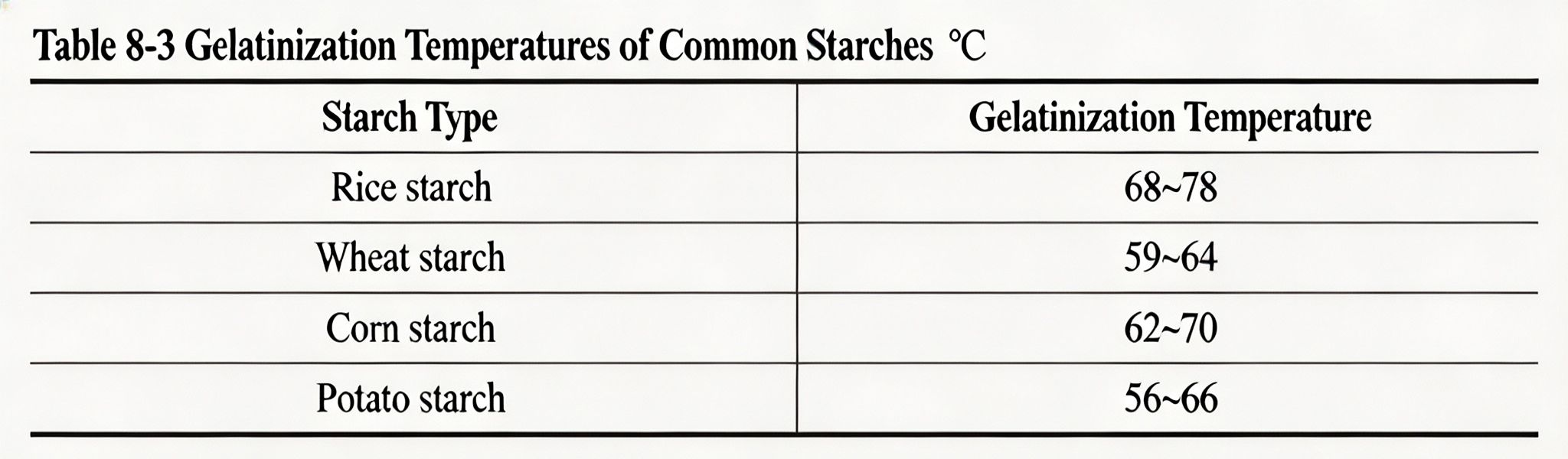
Under certain moisture content and temperature conditions, starch particles will swell and break, the ordered intermolecular hydrogen bonds inside break, and they disperse into a disordered state, resulting in gelatinization. The gelatinized starch is also called α-starch. The gelatinization temperatures of several common starches are listed in Table 8-3.
Cereal starches start to swell at a general temperature of 50-60℃, while legume starches start to swell at a temperature of 55-75℃. The denaturation temperature of raw materials varies with moisture content. The gelatinization temperature of pure wheat starch with 20% moisture content is 120℃.
The main change of starch during extrusion is gelatinization. After hydrothermal treatment, under the combined action of damp heat, mechanical extrusion, and shearing, the structure of starch particles is destroyed. The 1-4 glycosidic bonds in starch molecules break to produce low-molecular-weight products such as glucose, maltose, maltotriose, and maltodextrin. The intermolecular hydrogen bonds break and gelatinization occurs, that is, α-ization. Starch molecules break into short-chain dextrins and degrade into soluble reducing sugars.
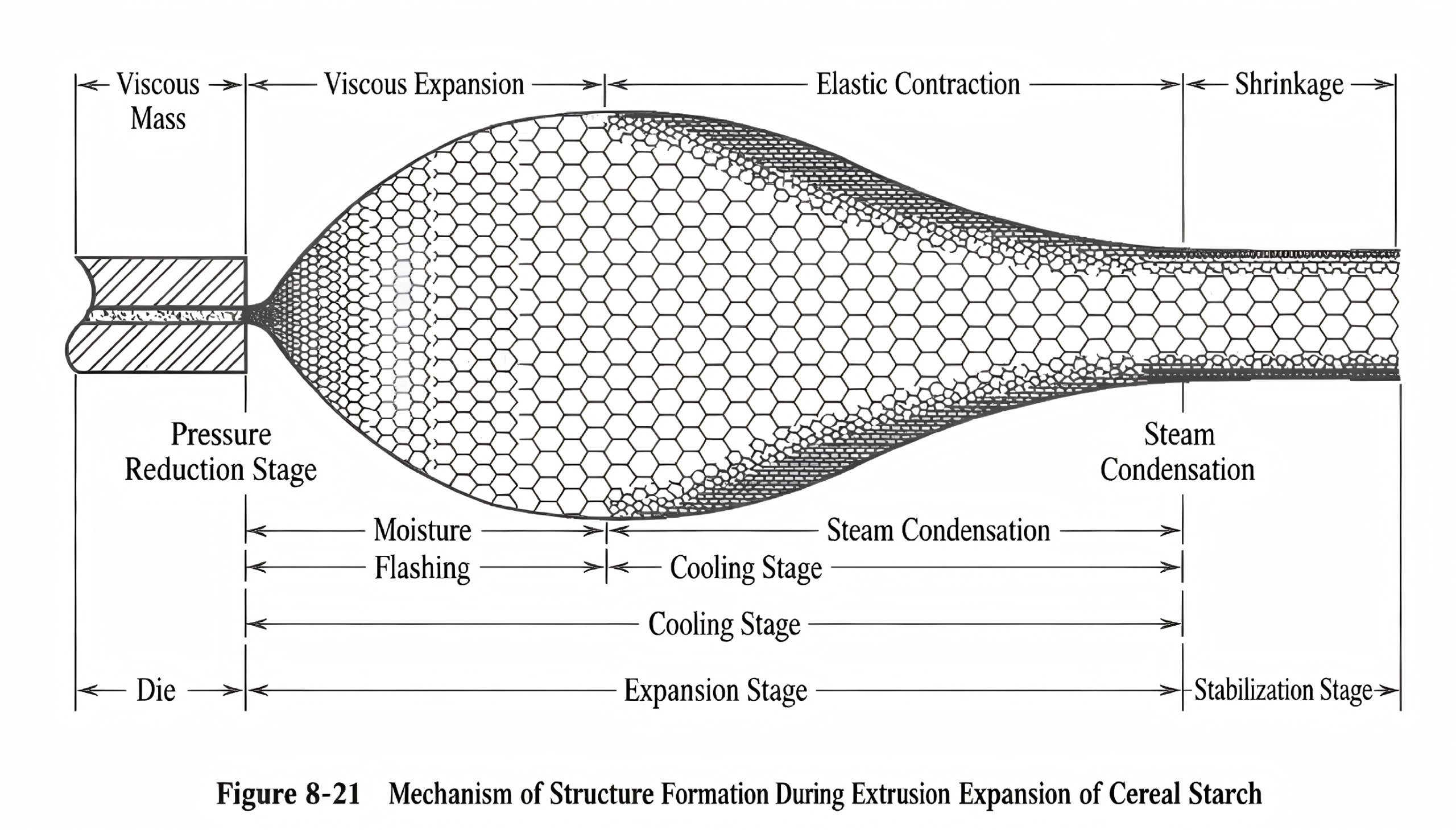
Gelatinized starch molecules cross-link with each other to form a network spatial structure. After instant expansion, the material loses part of its moisture, and becomes the skeleton of expanded feed after cooling, and the feed maintains a certain shape through this. Through expansion, the surface area of starch particles and the regions between semi-crystalline and crystalline regions is significantly increased, and their tissue structure is disintegrated, so that starch particles are integrated into a smooth area like plastic (Figure 8-21). This change can improve the digestibility of starch for suckling piglets with extremely low amylase activity.
(2) Fiber
Fiber raw materials in the feed industry mainly come from corn, oilseed meals, and bran. During the extrusion process, the general rule is that the expansion degree decreases as the fiber addition amount increases. However, fibers from different sources or with different purities have significantly different effects on the expansion degree.
Pea and soybean fibers have good expansion ability. When their addition amount in starch-based feed reaches 30%, they have no significant impact on the expansion degree of the final product; while oat bran and rice bran have poor expansion ability due to their high content of protein and fat.
(3) Hydrophilic Colloids
Hydrophilic colloids are mainly used in the production of special aquatic feed, usually including gum arabic, pectin, agar, carrageenan, and sodium alginate. Their gelling ability after extrusion generally decreases.
During the extrusion process, their hydrophilic properties will also affect conventional extrusion conditions, reduce the water evaporation rate and freezing rate of extruded products, and improve the texture performance of the product.
For a specific product, when selecting hydrophilic colloids, factors such as the colloid’s viscosity, gelling property, emulsifying property, hydration rate, dispersibility, taste, operating conditions, particle size, and raw material source should be carefully considered.
(4) Sugar
Sugar is hydrophilic. During the extrusion process, it affects starch gelatinization by regulating the water activity of the material. The high temperature and high shear of extrusion cause sugar to decompose to produce carbonyl compounds, which undergo Maillard reaction with proteins, free amino acids or peptides in the material, thus affecting the color of extruded expanded feed products.
In addition, during the extrusion process, adding a certain amount of sugar can effectively reduce the viscosity of the material, thereby improving the expansion effect when the material exits the die, which is helpful for controlling the buoyancy of aquatic feed. In extruded feed, besides providing energy, sugar is mainly used as a flavoring agent, sweetener, texture regulator, water activity and product color regulator. Commonly used sugars include sucrose, dextrin, fructose, corn syrup, molasses, xylose, and sugar alcohols.
II. Protein
When protein raw materials are subjected to moisture, high temperature, high pressure, and strong mechanical shear in the expansion chamber of the extruder, protein denaturation occurs, producing flocculent precipitation or forming a gel structure. This denaturation allows protease to more easily enter the interior of the protein, thereby improving digestibility. When extruded through the die hole, high temperature, high pressure, and high shear force can make protein molecules form textured protein. For example, extruders are used to produce soy protein isolate.
Most proteins present a linear structure along the flow direction of the material, which leads to intermolecular rearrangement. The effects of extrusion expansion on protein are mainly shown in the following aspects.
(1) Denaturation
When protein is heated or affected by other physical and chemical effects, its unique structure and properties change accordingly, such as decreased solubility, increased sensitivity to enzymatic hydrolysis, and loss of activity. This phenomenon is called denaturation. Denaturation does not mean that protein is decomposed; it only means that the secondary and tertiary structures of protein change. Moderate damage to protein structure can improve the digestibility of protein.
(2) Thermal Denaturation
The coagulation of egg white when heated and the contraction and hardening of lean meat during cooking are both caused by thermal denaturation of protein. After protein is thermally denatured, its sensitivity to enzymatic hydrolysis increases.
(3) Enzyme Inactivation and Sterilization
Thermal sterilization also utilizes the principle of protein denaturation. For example, extrusion expansion can inhibit or inactivate trypsin inhibitor in soybeans, and can also inactivate lipase in rice bran, slow down the spoilage of rice bran, and extend the shelf life of rice bran.
(4) Decrease in Protein Dispersibility Index
Due to the presence of starch in raw materials, gelatinized starch wraps other nutrients in the starch matrix, and protein is physically bound within the gelatinized starch and protected by the starch matrix. Simple aqueous solution cannot dissolve protein, but digestive enzymes in the intestinal tract can easily dissolve the starch matrix and release the protein.
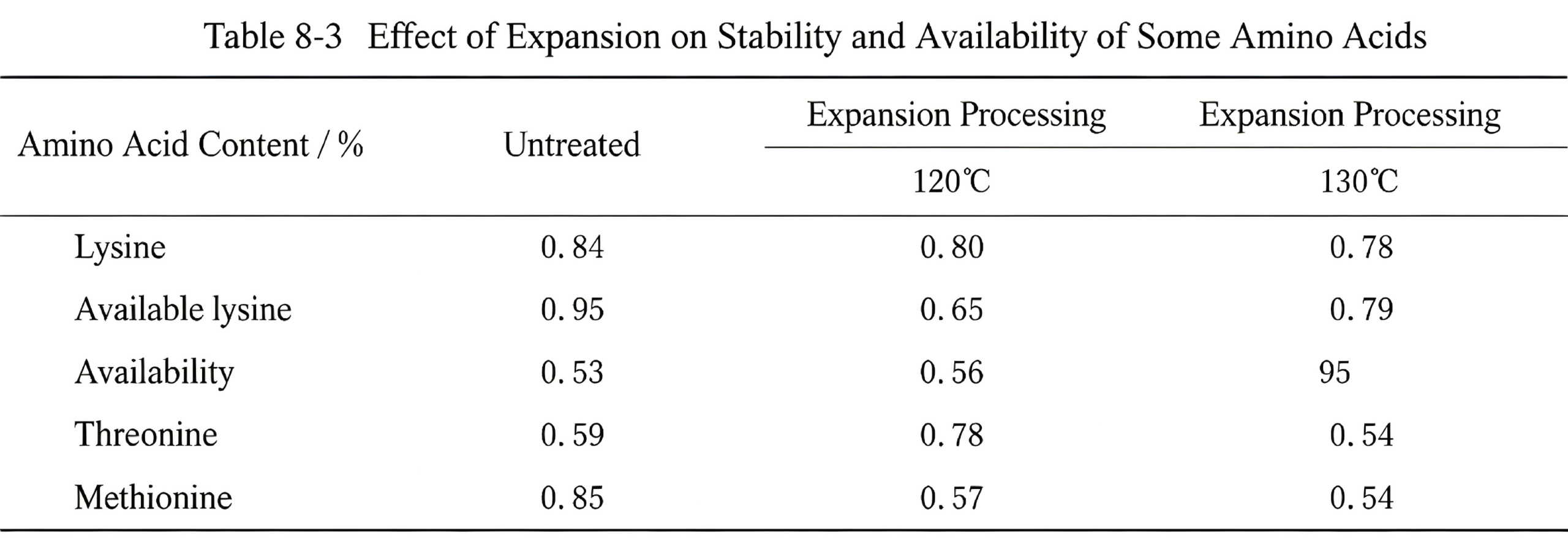
The effect of expansion on the stability and availability of some amino acids is shown in Table 8-4.
In general, after extrusion expansion, the protein content will decrease to some extent. Lysine has obvious loss, followed by methionine. The loss of amino acids increases with the increase of temperature and decreases with the increase of moisture. The content of starch (sugar) in raw materials will lead to a decrease in amino acid content to a certain extent. The effect of sugar on amino acid content mainly comes from Maillard reaction.
III. Fat
Studies have shown that during extrusion, part of the fat in the raw material forms complexes with starch and protein, which reduces the content of free fat in the extrudate. For example, after extrusion expansion, the content of free fat in corn decreased from 4.22% to 1.65%.
The higher the extrusion temperature, the higher the content of free fat in the extruded sample, and the less the amount of complex generated. Similarly, the higher the moisture content, the higher the content of free fatty acids in the extruded sample, and the generation of complex decreases.
Extrusion will partially hydrolyze the triglyceride in the feed to produce monoglycerides and free fatty acids, increasing the content of free fatty acids in the product. In terms of simple treatment, the extrusion process will reduce the stability of oil and fat. However, for the whole product, the content of free fatty acids in extruded products during storage is significantly lower than that in unextruded samples, because extrusion inactivates factors such as lipase and lipoxygenase in feed that promote fat hydrolysis.
The formation of fat complexes protects fat by starch and protein, thereby reducing the oxidation rate and degree of oxidation. Fat and its hydrolysates can form complexes with gelatinized starch during extrusion, so that fat cannot be extracted by petroleum ether. However, this complex can dissociate in the acidic digestive tract and does not affect the digestibility of fat.
IV. Vitamins and Minerals
Extrusion expansion causes a large degree of loss to heat-sensitive vitamins, and different vitamins have different degrees of loss. Among them, the loss rate is less than 10% for vitamin B2, niacin, and pantothenic acid. The loss rate of vitamin B₁ is 10%–20%, the loss rate of vitamin B₆ is 20%–30%, the loss rate of vitamin D₃ is 30%–60%, the loss rate of vitamin A and vitamin E is 50%–70%, and the loss rate of vitamin K₃ can be as high as 60%–90%.
The rule is that as the expansion temperature, pressure, and moisture content of the material increase, the loss rate increases. Using stable dosage forms and treatment processes such as coating and microencapsulation can reduce the loss rate of vitamins during extrusion by 10%–30%. From the perspective of production convenience, adding vitamins before extrusion expansion is better than adding after extrusion expansion, but it must be added in excess to overcome the loss of vitamins during extrusion.
Extrusion will cause damage to vitamins, and the loss of vitamins during storage of feed will also accelerate. Adding after extrusion is more economical, but it requires special post-spraying equipment.
During extrusion, minerals are generally not destroyed, but the formation of new complexes with coagulation properties may reduce the bioavailability of some minerals. For example, phytic acid may complex with ions such as Zn and Mn to form compounds that cannot be digested by animals.
Extrusion expansion has a certain impact on the bioavailability of minerals. It is generally believed that the bioavailability of minerals in plant feed is affected by phytic acid content, and extrusion expansion improves the utilization rate of phytic acid phosphorus.
V. Anti-nutritional Factors
Another advantage of extrusion expansion processing is that it destroys anti-nutritional factors in feed raw materials, such as trypsin inhibitors (TI) in soybeans and gossypol in cottonseeds. TI inhibits the activity of trypsin and reduces the digestibility of protein. Extrusion expansion processing can destroy most TI.
Factors such as extrusion temperature, moisture content, equipment configuration, retention time, and die hole size all affect the degree of damage to anti-nutritional factors such as TI. According to research reports, using a single-screw extruder to expand full-fat soybeans can inactivate more than 95% of TI, while after treating full-fat soybeans with a twin-screw extruder, TI activity is completely lost. Extrusion expansion also has a destructive effect on free gossypol in cottonseed meal and glucosinolates in rapeseed meal.