
The special digestive physiology of the rumen of ruminants determines that ruminant feed cannot simply copy the feed processing technology of monogastic livestock and poultry. The core goals are: protecting the rumen, improving rumen bypass nutrition, improving palatability, reducing processing loss, improving feeding efficiency, reducing costs and reducing emissions. Innovation is mainly concentrated in several directions: pretreatment, conditioning pelleting, rumen bypass processing, mixing, complete sets of equipment, and digital processing.
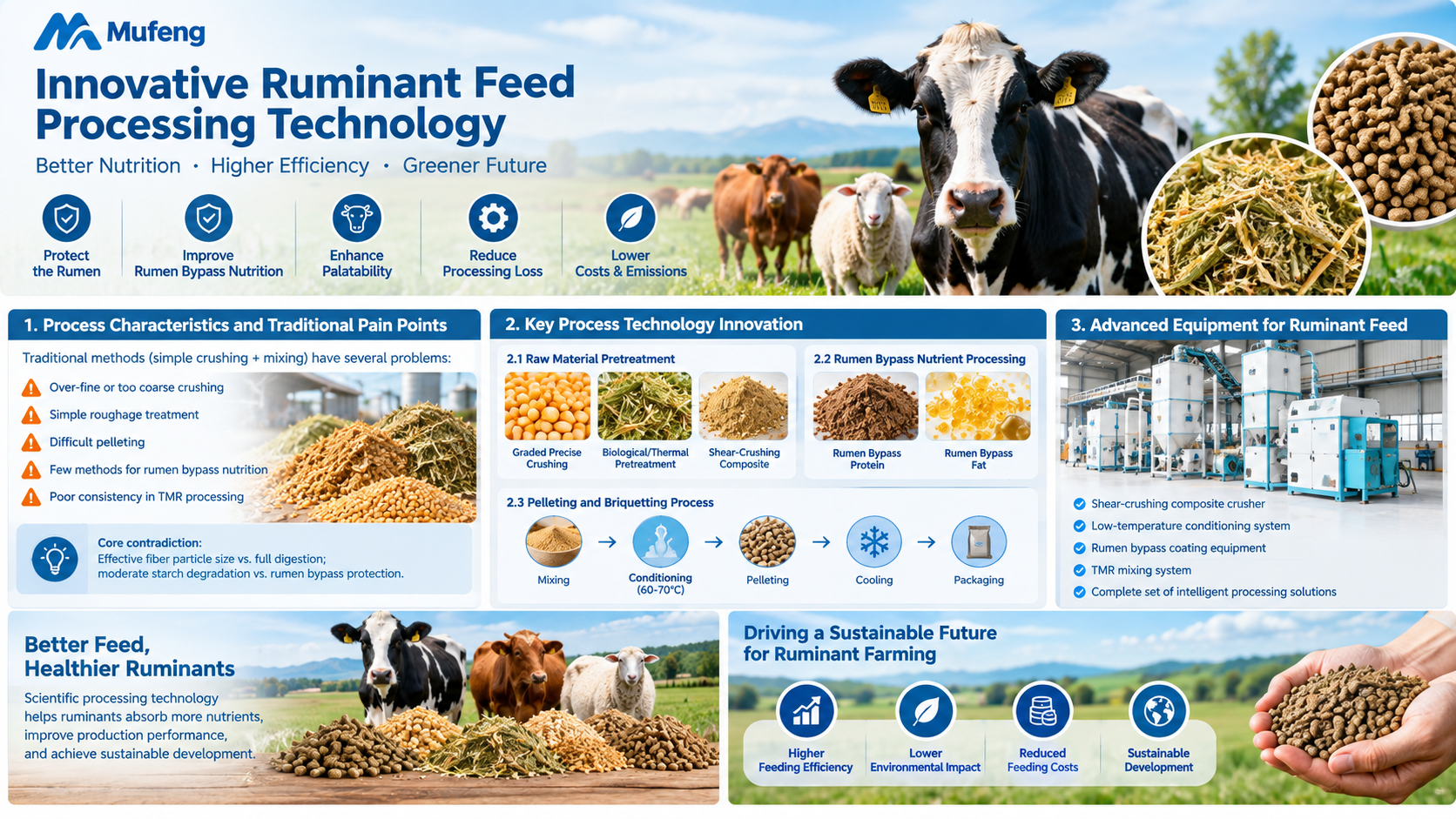
1. Process Characteristics and Traditional Pain Points of Ruminant Feed
Most traditional ruminant feeds use simple crushing + mixing, and there are prominent problems:
– Over-fine crushing: When starch is crushed too finely, it will ferment rapidly in the rumen, which is easy to cause acidosis and hoof disease; if crushing is too coarse, the nutrient digestibility is low.
– Simple roughage treatment: The particle size of chopped straw and hay is unreasonable, and the effective fiber is insufficient.
– Difficult pelleting: With high proportion of coarse material and high fiber content, it is difficult to pelletize, the particles are easy to loose, and the energy consumption is high.
– There are few processing methods for rumen bypass nutrition, and the rumen bypass rate is unstable.
– The consistency of industrial processing of TMR (Total Mixed Ration) is poor, with stratification and grading, resulting in uneven feed intake of animals.
The core contradiction of ruminant feed processing technology: ensuring effective fiber particle size vs. full digestion; moderate starch degradation vs. rumen bypass protection.
2. Key Process Technology Innovation
2.1 Innovation of raw material pretreatment technology
(1) Graded precise crushing (differential crushing)
Instead of crushing all materials uniformly, set the crushing particle size according to different raw materials:
– Cereals (corn, barley): medium particle size, avoid being too fine, control the rumen degradation rate;
– Protein raw materials: moderately fine crushing to improve small intestine digestion;
– Roughage (straw, alfalfa, leymus chinensis): shear and shred instead of excessive hammer milling, retain long fiber fragments to maintain effective NDF.
Equipment innovation: Shear-crushing composite crusher, adjustable gap hammer + double-roller combined crushing, can adjust particle size online, achieve fine grain and keep long fiber for coarse material.
(2) Biological/thermal pretreatment of roughage
1) Steam explosion pretreatment of straw: Low-pressure and short-time steam explosion destroys the structure of lignocellulose, improves the digestibility of straw; reduces fiber hardness and improves pelleting performance.
2) Raw material conditioning and curing: Low-temperature conditioning of grains (60-75℃), moderately gelatinize starch, do not pursue high gelatinization degree, control rumen starch degradation, which is different from high-temperature conditioning of pig and chicken feed.
3) Silage/hay pretreatment: Dust removal, impurity removal, and briquetting reduce dust and facilitate storage, transportation and subsequent processing.
2.2 Innovation of rumen bypass nutrient processing technology (the core technology of ruminant feed)
(1) Processing of rumen bypass protein
1) Hot-pressing coating technology: Soybean meal and rapeseed meal are moderately thermally modified, which produces Maillard reaction, reduces rumen degradation rate and increases small intestine absorbable protein; control temperature and time to avoid excessive denaturation and inactivation of protein.
2) Oil coating process: Drum coating and fluidized bed coating are used to coat amino acids (methionine, lysine) and protein raw materials with fat; The difficulty lies in that the coating layer is uniform, resistant to rumen fluid, and dissolves in the abomasum and small intestine.
3) Moderate aldehyde treatment process: Environmentally friendly modified treatment replaces traditional formaldehyde treatment to improve rumen bypass rate.
(2) Processing of rumen bypass fat
Special process for calcium soap fatty acid salts: High temperature reaction → cooling granulation to produce fatty acid calcium, which does not interfere with rumen microorganisms and increases energy;
High saturated fat microcapsule coating improves rumen bypass rate and solves the problem that excessive oil inhibits fiber digestion.
Key points of the process: The coated material cannot be conditioned at high temperature for a long time to prevent the coating layer from being damaged. Many manufacturers copy the conditioning of livestock and poultry feed, which directly causes the failure of rumen bypass products.
2.3 Innovation of pelleting and briquetting process
Ruminant feed is divided into: concentrate supplement pellets, total mixed TMR pellets, roughage briquettes.
1) Low-temperature conditioning pelleting process: The conditioning temperature is 60-70℃, with low steam addition, reducing excessive starch gelatinization and protecting the rumen bypass coating layer; For high-fiber formulas, the opening rate and compression ratio of the ring die are optimized.
The compression ratio of livestock and poultry feed is 12-16, and the compression ratio of ruminant concentrate supplement is generally 8-12; The compression ratio of high-fiber TMR particles is further reduced.
2) Innovation of TMR pelleting technology
Pelletizing after mixing all components of concentrate + hay + straw solves the problems of easy stratification and troublesome transportation and feeding of traditional TMR; Technical difficulties: high crude fiber content, difficult pelleting, and easy cracking of particles.
Innovative process: Pre-shredding of roughage → graded batching → double-shaft high-efficiency mixing → low-temperature conditioning → large-aperture ring die pelleting → gentle cooling.
Advantages: It is convenient for large-scale factories to produce complete ruminant pellets, and cattle and sheep do not pick food when eating.
3) High-density briquetting/compression packaging equipment for roughage
Briquetting alfalfa and straw reduces storage and transportation costs; The new two-way briquetting equipment improves briquetting density and reduces energy consumption.
2.4 Innovation of mixing process
Ruminant feed contains long fibers, oils and trace additives, which are easy to stratify.
1) Double-shaft paddle mixer is the mainstream. Innovation: segmented feeding process, long fibers are pre-mixed first, and oil is sprayed by atomization in the later stage to avoid fiber agglomeration;
2) Online trace addition system: Rumen bypass amino acids, enzyme preparations and probiotics are sprayed after low temperature, and do not go through conditioning and pelleting, avoiding high temperature inactivation.
Post-spraying technology is becoming more and more important: probiotics, enzymes, essential oils, and vitamins are sprayed with liquid after pelleting and cooling to retain their activity.
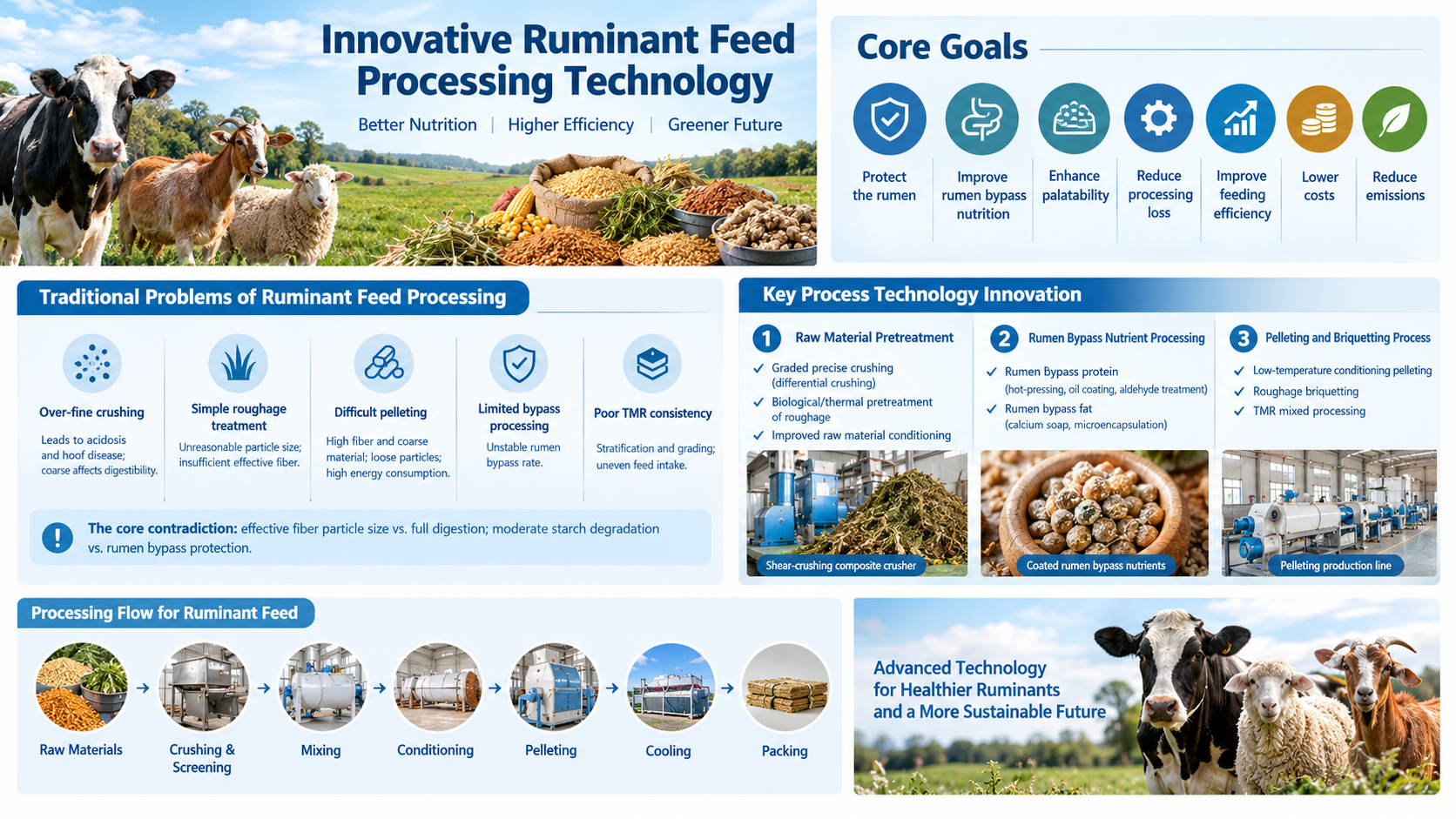
3. Innovation Direction of Core Equipment
– Composite shear crushing equipment: It combines hammer crushing and shear shredding, can process grain and roughage separately, outputs controllable particle size, and ensures effective fiber.
– Low-temperature conditioner: Low steam input and prolonged conditioning time, control the temperature within 70℃, adapt to rumen bypass materials, and avoid coating melting.
– Special ring die pellet machine with large aperture and low compression ratio: It is specially used for ruminant feed, improves the production capacity of high-fiber formula and reduces particle breakage.
– Fluidized bed coating machine and continuous drum coating system: It is used for coating rumen bypass amino acids and proteins to achieve continuous large-scale production.
– Industrial TMR complete set unit: It can automatically unpack, remove impurities, shear, continuously batching and mix roughage, and can produce TMR bulk materials or TMR particles.
– Post-spraying system: It realizes online accurate spraying of oil, probiotics and plant essential oils, which is completed at the back end of the cooler.
– Online near-infrared NIR testing equipment: It detects NDF, ADF, crude protein and starch in real time on the production line, and adjusts the formula process in real time.
– Intelligent batching: Dynamic weighing of roughage solves the proportioning error caused by the fluctuation of hay bulk density.
4. Product Effects Brought by New Technology
– The utilization rate of rumen bypass protein and rumen bypass fat is improved, and the milk yield of dairy cows and the weight gain of mutton sheep are improved;
– Starch degradation is controllable, reducing the risk of rumen acidosis and subacute acidosis;
– TMR pellets solve the problem of picky eating, make feed intake uniform, and reduce feed waste;
– Efficient utilization of by-products such as straw reduces raw material costs;
– Nitrogen excretion is reduced, and aquaculture emission reduction is realized.
5. Existing Technical Difficulties and Future Innovation Trends in the Industry
1) Difficulties
– High-fiber TMR pellets: low production capacity, large equipment wear, and high production cost;
– The quality of coated products fluctuates greatly. If the temperature and moisture in the processing process are slightly out of control, the rumen bypass rate will drop significantly;
– The quality of roughage raw materials fluctuates greatly, and the process parameters need to be adjusted dynamically.
2) Future innovation directions
① Green physical processing: Steam explosion and extrusion modification replace chemical treatment, which is environmentally friendly;
② Integration of low-temperature processing + post-spraying to retain active substances to the maximum extent;
③ Process digitalization: NIR online detection + AI automatically adjusts crushing particle size, conditioning temperature and ring die parameters;
④ Customized process: For different stages of dairy cows, beef cattle and mutton sheep, set differentiated crushing, conditioning and pelleting parameters, and no longer use one process for all ruminant feeds;
⑤ Efficient utilization process of by-products: Integrated pretreatment processing of distiller’s grains, fruit residues and straw.