In the production process of expanded feed, good steam conditioning is one of the key links. Different amounts of saturated steam are added into the conditioner to bring the material to a certain temperature and moisture content. The fresh product exiting the machine has a moisture content of 22%–28% and a temperature of 80–135°C. At this point, the pellets are generally relatively soft and may not be fully gelatinized. To improve the hardness and degree of gelatinization of the material, post-conditioning treatment is usually required for the expanded products.
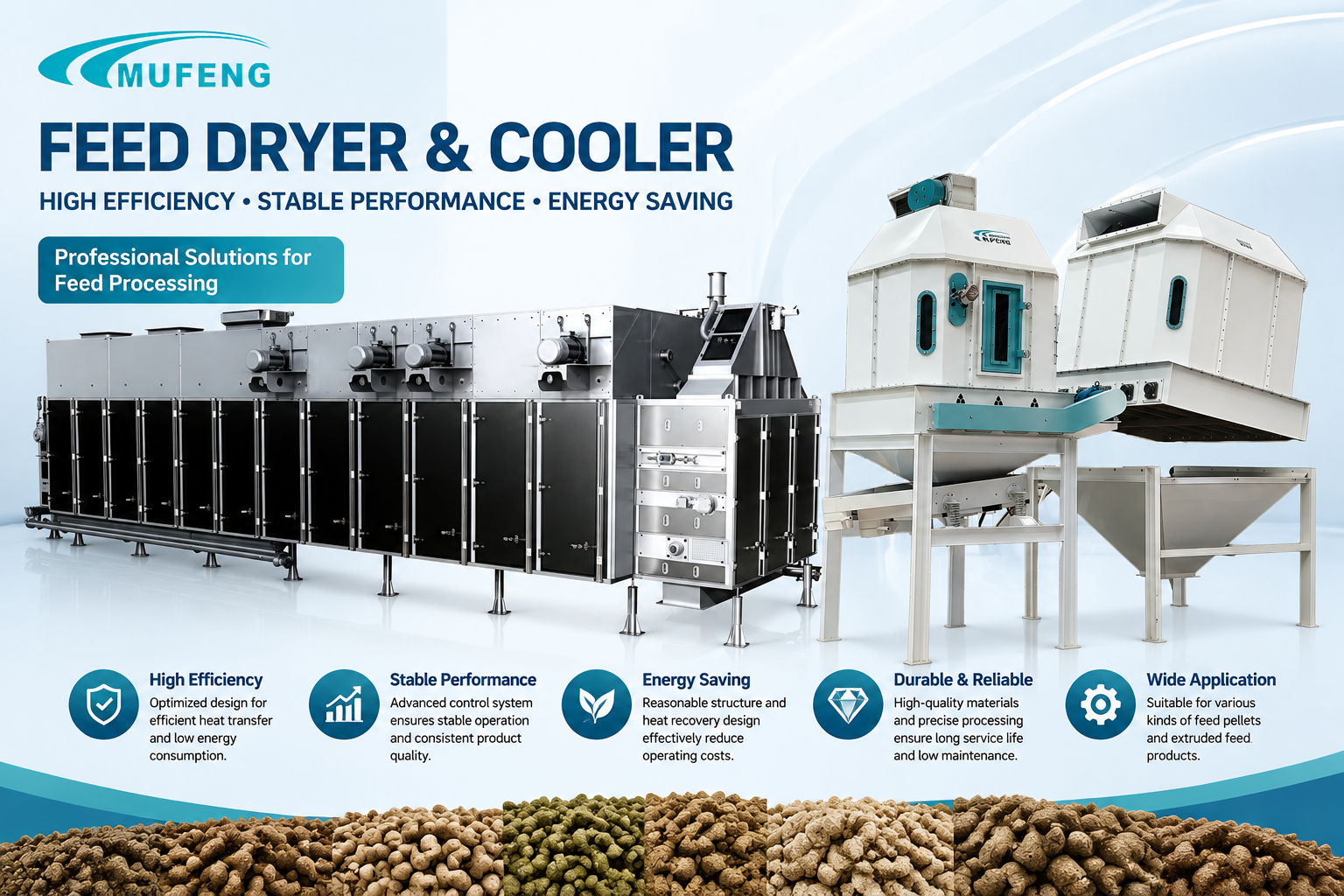
Usually, expanded products are subjected to hot air at 150–190°C for the first 4–6 minutes after being fed into the dryer without damaging their nutritional value. However, in the second half of the drying cycle, the air temperature should be lowered to avoid the Maillard reaction, which reduces the nutritional value of the product. After drying, the moisture content of the material decreases, but the temperature is high, so it must be cooled and have its temperature lowered. Some manufacturers design the dryer and cooler as an integrated unit, namely a dryer/cooler. The upper part of the multi-channel dryer is for drying, and the lower part is for cooling. The cooling of the material is mostly done by suction air, utilizing ambient air to complete cooling, temperature reduction, and drying.
I. Post-conditioning
The post-conditioning process involves heating the working air → the heated air is sucked in by the circulation fan → the hot air is applied to the product → the hot air transfers energy to the product → the heat in the hot air evaporates the moisture on the surface of the product → the water vapor is sucked away by the circulation fan → part of the circulating air is exhausted → fresh air replaces the exhausted air → the cycle repeats. The post-conditioning process is also referred to as the drying process.
II. Drying/Cooling
Common drying equipment includes two types: horizontal dryers and vertical dryers.
- Horizontal Dryer
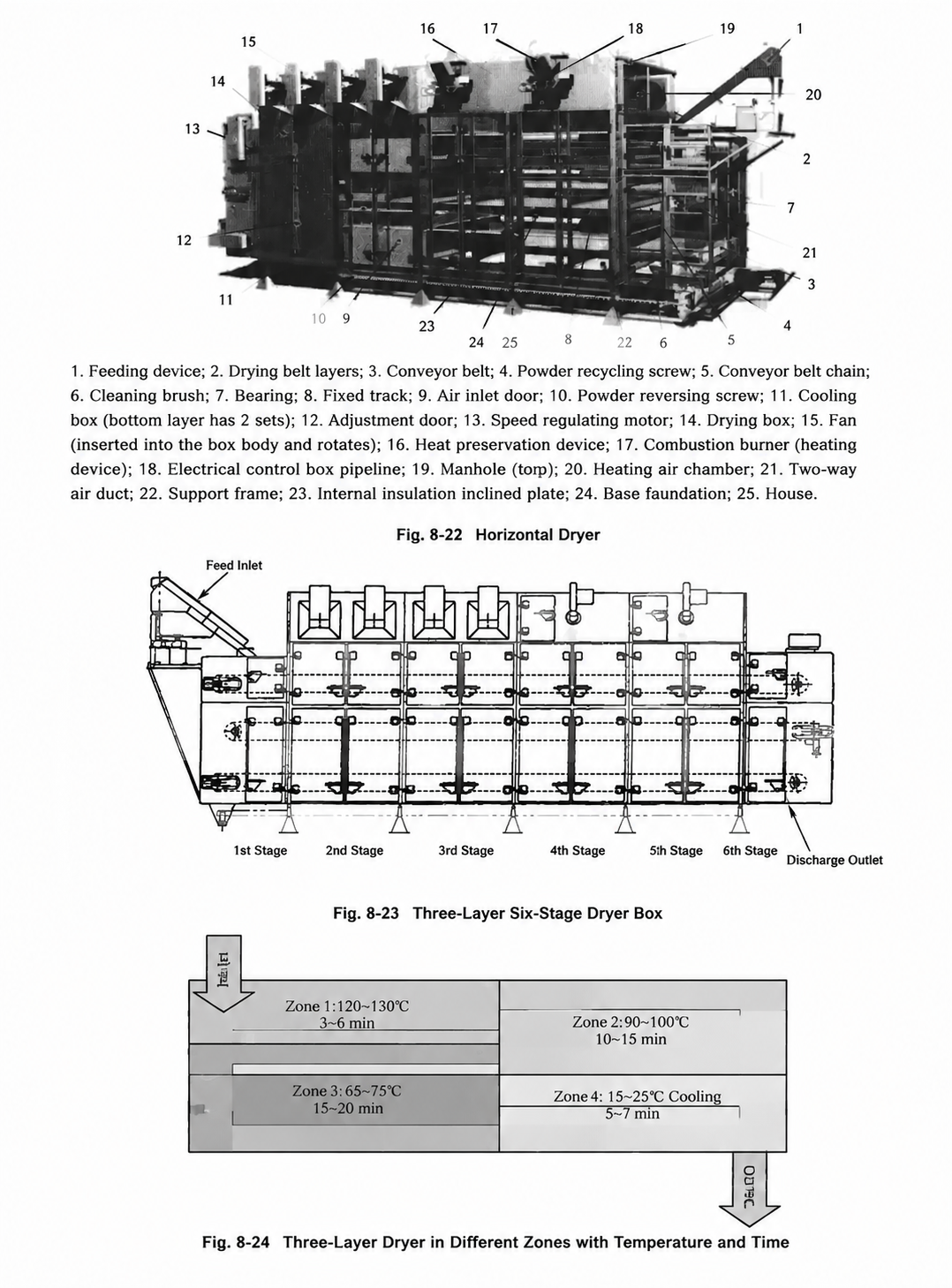
For a horizontal dryer (Figures 8-22 to 8-24), its drying conveyor belt has a 1–3 layer structure, and each layer is equipped with a powder discharge screw conveyor. It adopts a high-tensile conveyor chain, where the conveyor belt is made of hinged or overlapping mesh plates, or can use polyester or stainless steel perforated plates. Its conveyor belt uses single-stage or multi-stage variable speed transmission. The top is equipped with a circulating drying fan (plug-in structure), and hot air can be heated by direct or indirect methods, namely using steam heating or direct ignition heating on a combustion furnace using gas, liquefied gas, or other fuels. The drying box consists of several boxes, which can be added as needed to increase processing capacity. Generally, the last two sections at the bottom of the horizontal dryer are the cooling section, separated from the drying section, and the air discharged after cooling serves as a supplement for the dryer air. The doors in the drying air ventilation duct are connected by hinges and can adjust the airflow reversely.
- Vertical Dryer
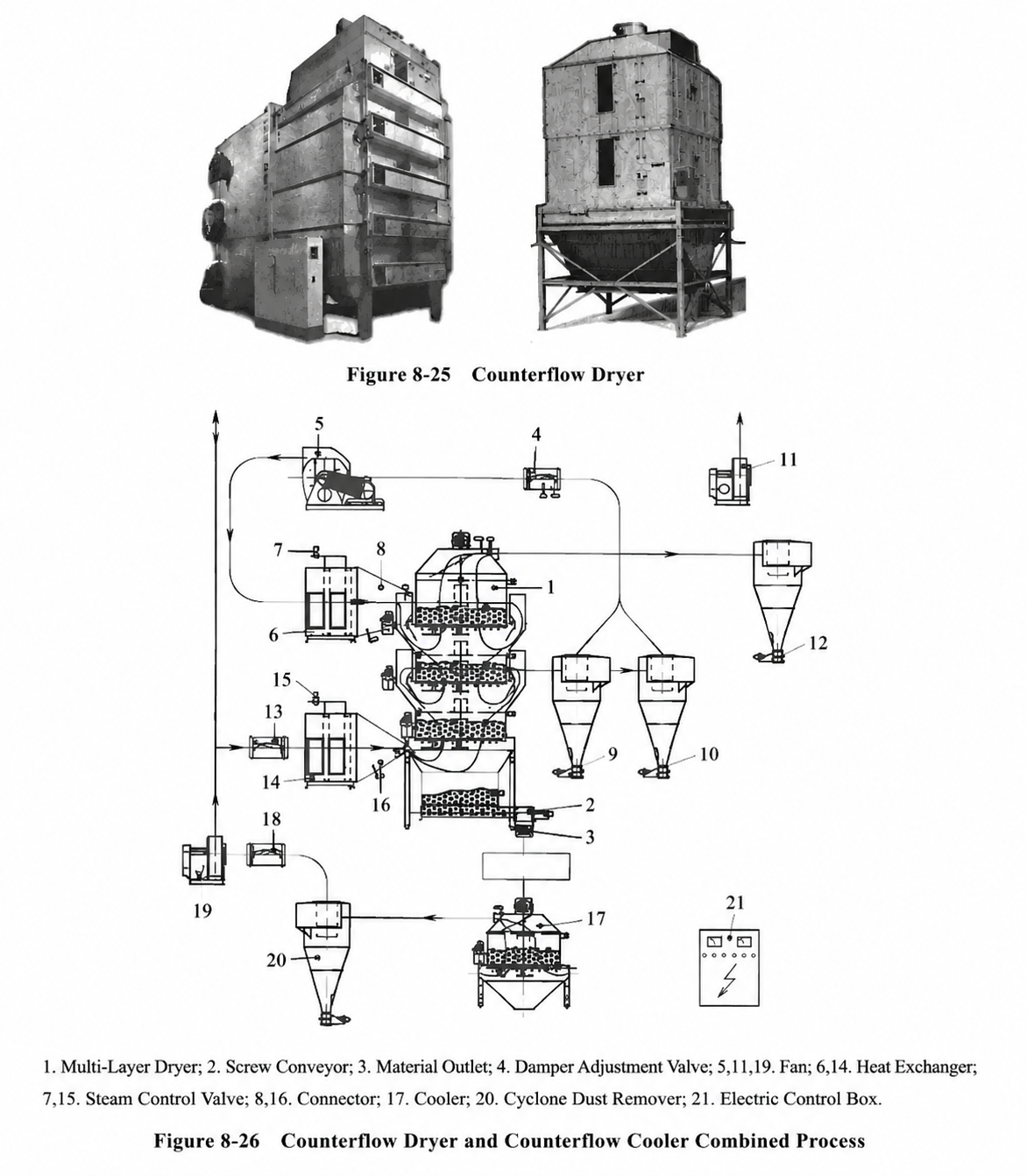
The vertical dryer adopts the principle of a counter-flow cooler, sucking in preheated air and passing it through the material layer to dry the pellets. The drying tower consists of 1–5 layers and can also be combined with a cooler to complete drying and cooling in the same tower body. The material flow between the layers of each box works in an intermittent state, automatically controlled by a PLC program controller. During batch discharging, the hydraulic control controls the opening size of the rotating positioning discharge screen to control the discharge progress and drying time.
The batch discharge process of a 5-layer drying tower: after the bottom layer is emptied, the discharge screen resets, the second layer discharge screen opens, and so on until the top layer opens to release material for the new batch. The entire work cycle takes approximately 10 minutes. The combined process of a counter-flow dryer and a counter-flow cooler is shown in Figures 8-25 and 8-26.
If the product is packaged or stored in bulk without cooling, the remaining moisture in the product will transfer to the coldest part of the packaging or storage device (e.g., the container wall). This phenomenon is called the heat transfer phenomenon of moisture. It will lead to a local increase in moisture content, which is liable to cause deterioration.
- Precautions for operating dryers and coolers
The following points must be noted when operating dryers and coolers:
① The feed coming out of the extruder is slightly plastic, especially materials with high starch content, and is slightly sticky. Therefore, the product should not be piled too thick to reduce deformation and caking;
② The feed should be turned and agitated during the drying process to promote drying and break up lumps; it is best to use 2-stage or multi-stage drying;
③ The airflow should pass through the product relatively quickly and evenly;
④ To adapt to the characteristics of the product, the residence time and material layer thickness of the product in the dryer and cooler should be adjustable.