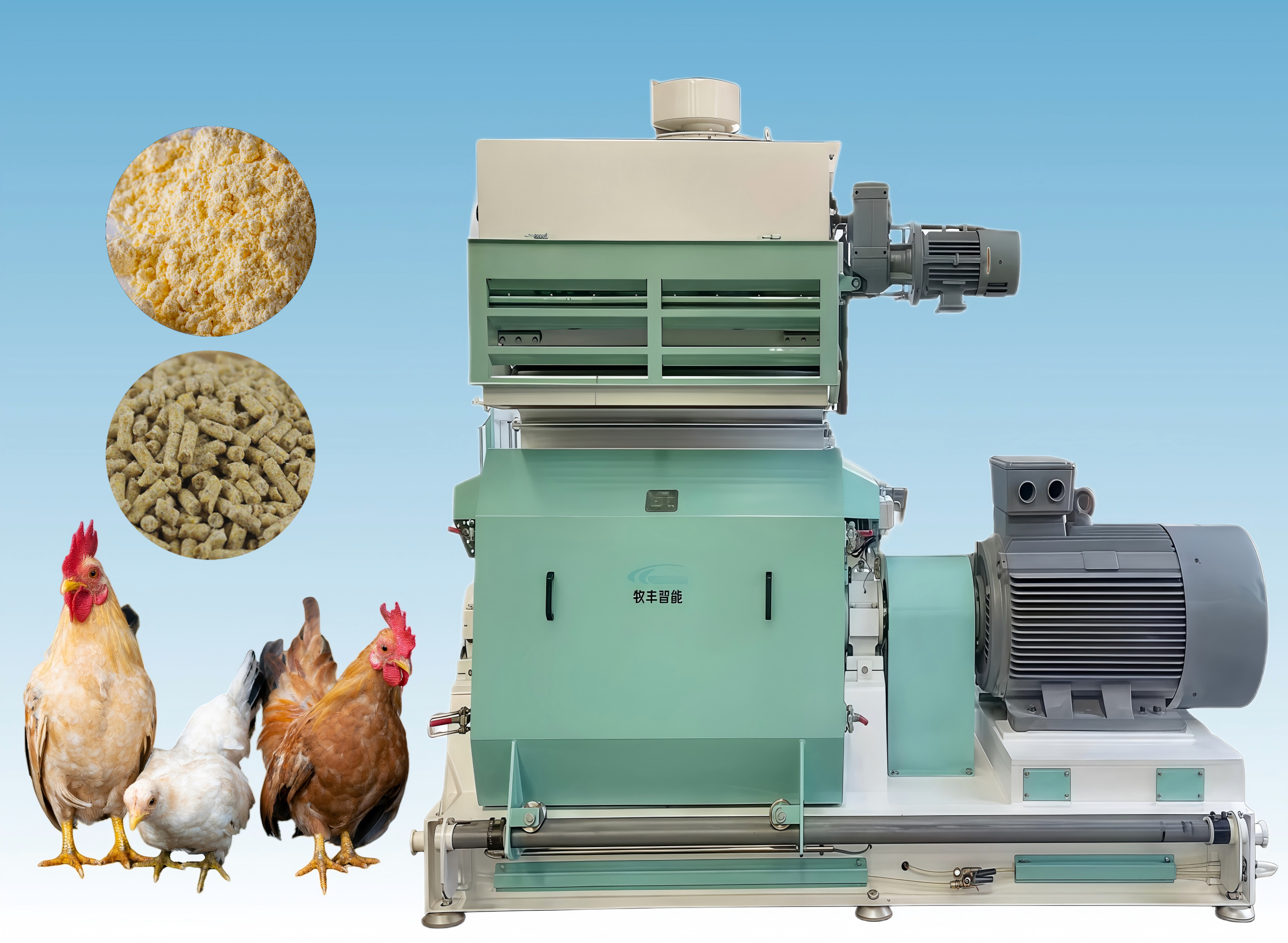

Extruder technology is widely used in the aquafeed industry. Compared to pellet mills, extruders offer greater product versatility, achieve a higher degree of starch gelatinization, and result in significantly less environmental impact. Consequently, many manufacturers focus exclusively on producing floating feed. The following points outline key considerations for producing sinking feed using an extruder:
1. Formulation: When designing a formula for sinking feed, starch content should be kept low—ideally between 10% and 20%, with 15% being a typical target. Insufficient starch can compromise the water stability of the pellets and increase the amount of “fines” (dust), which negatively affects the appearance of the final product. Additionally, sinking feed formulas generally require a higher fat content—typically 5% to 8%—compared to floating feed. It is also worth noting that plant-based ingredients are generally easier to extrude than animal-based ingredients.
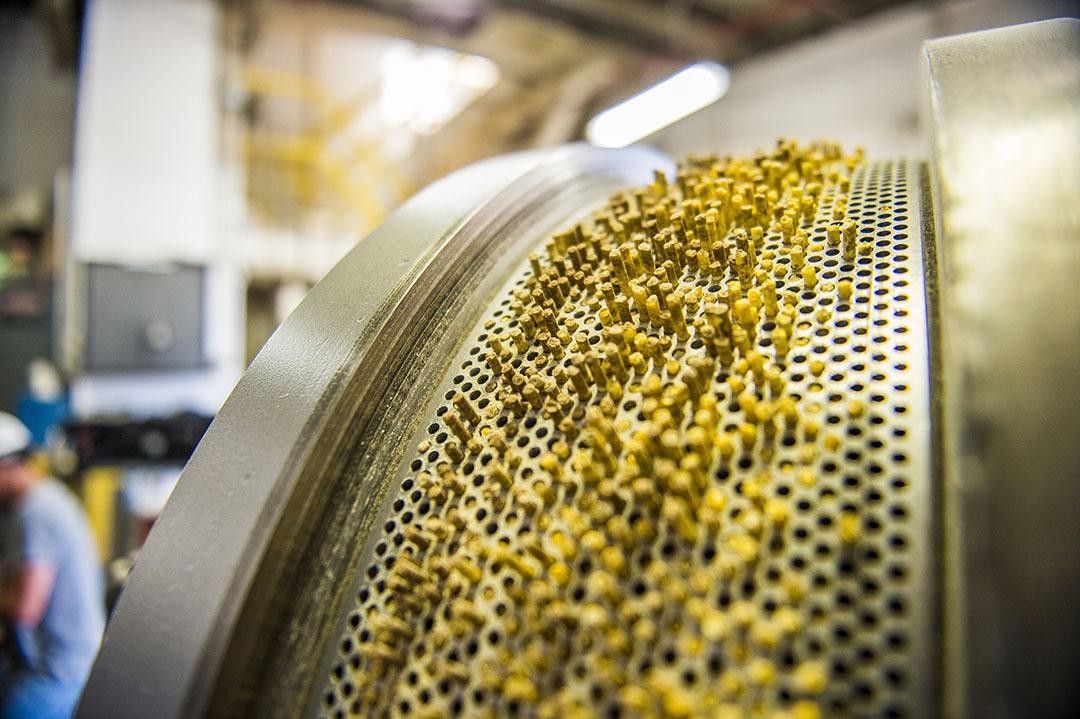
2. Die Plate: The open area ratio of a die plate used for sinking feed should be at least 40% higher than that used for floating feed. This is because a smaller pressure differential between the inside of the extruder barrel and the external atmosphere is required to minimize the degree of expansion. Furthermore, the length-to-diameter (L/D) ratio of the die holes should be greater than that used for floating feed—typically around 1:1.8.
3. Screw Configuration: The screw configuration for producing sinking feed differs from that used for floating feed. It requires a shorter residence time for the material within the barrel (e.g., 20–30 seconds for sinking feed, compared to 30–35 seconds for floating feed on the same equipment). Additionally, the configuration should minimize shear force and result in a lower discharge temperature. Therefore, when producing sinking feed, notched (interrupted) screw elements should be avoided near the discharge end, and pressure-relief ports on the extruder barrel should be opened whenever possible. Furthermore, screw elements positioned after the kneading/mixing discs (toward the discharge end) should be oriented with their steep-angled faces pointing toward the die, facilitating the rapid exit of the material.
4. Moisture Control: When producing sinking feed, the amount of water added during the conditioning process should be slightly higher than that used for floating feed (moisture levels after conditioning are typically around 25% for floating feed and 28% for sinking feed). Additionally, 2–3% more water (tap water) can be introduced directly into the extrusion chamber, which further facilitates the production of sinking feed.
5. Conditioning Temperature Control: Generally, there is little difference in conditioning temperature between floating and sinking feed; in both cases, it should be above 90°C to ensure proper starch gelatinization (typically 70–85% for sinking feed and 80–95% for floating feed). However, due to specific formulation requirements, some sinking feed recipes may not allow for a conditioning temperature of 90°C, limiting it instead to 60–80°C. In such cases, one can reduce the water added during conditioning and increase the water added directly into the extrusion chamber, which may allow the conditioning temperature to be raised.
6. Main Shaft Speed: For sinking feed, the main shaft speed is typically between 250 and 400 rpm (this applies to equipment with adjustable speed, such as twin-screw extruders; single-screw extruders generally lack speed-adjustment features and typically operate at around 350 rpm). Higher equipment rotational speeds result in greater shear force, which increases the mechanical energy absorbed by the feed.
7. Dryer Control: Many operators believe that higher dryer temperatures lead to more effective drying. However, when producing sinking feed, one must account for “secondary gelatinization”—a process where, if the temperature of the feed upon exiting the extruder (e.g., 80°C) is lower than the temperature inside the dryer (e.g., 120°C), the starch within the pellets undergoes further gelatinization. This can cause pellets that were sinking when they left the extruder to become buoyant after drying. Furthermore, excessively high dryer temperatures can lead to uneven moisture distribution between the surface and the core of the pellets. Therefore, when drying sinking feed, the guiding principle should be “low-temperature, slow-drying.” The drying temperature should be maintained at approximately 100°C—ideally below 90°C—with the conveyor belt speed set as slow as possible (requiring a residence time of 40–60 minutes).
For floating feed, the expansion ratio upon exiting the extruder die typically ranges from 1.5 to 2.1 times the original size. Sinking feed exhibits minimal expansion, with an expansion ratio of 1.0 to 1.3. In other words, the dimensions of the finished product will be larger than the die orifice, corresponding to the specific expansion ratio.
For reference only!!